Monday, February 05, 2007

Zuppa di Lenticchie

W
e've been having a cold snap here in Sarasota, with the temperature dropping into the fifties during the day. I understand that to my brethren, say, north of the Mason-Dixon line, temperatures in the fifties may not exactly constitute a cold snap at this time of year. But here in this neighborhood, it makes the case for the "thinning blood" theory.

Zuppa di Lenticchie
Some local hands have made the claim that blood thins in warm climates, and those of us who live here have therefore become more sensitive to cool temperatures. I'm not seeing a lot of science involved in this reasoning, but I can say that three or four weeks ago, I'd be wearing a polo shirt if the temperature went into the fifties in Connecticut.

No matter, though, the temperature favored a comforting meal. One such comfort food—for me anyway—has always been lentils.

Italian lore says that if you eat lentils on New Year's Day, you'll have good luck all year long. I feel pretty lucky, though, any time I eat lentils.

And certainly one of the most comforting elements of this dish is that it goes from stove to table in approximately half an hour.

Zuppa di Lenticchie
Lentil Soup

Ingredients:

1 Clove garlic, peeled, and coarsely chopped
1 Medium onion, peeled, and quartered
1 Medium carrot, peeled, and coarsely chopped
1 Medium stalk celery, washed, and coarsely chopped
1/4 Cup flat-leaf Italian parsley, chopped
1/4 Lb. Pancetta, chopped
Olive oil
1 Lb. Dried lentils, washed, and picked over
Salt & freshly-ground black pepper
1/2 tsp. Dried red pepper flakes
Juice of 1/2 Lemon, OR 2 Tbs. red wine vinegar

Preparation:

Place the garlic, onion, carrot, celery, parsley, and pancetta in a Cuisinart, and pulse ten times for approximately one second per pulse.

Heat enough olive oil to cover the bottom of a 3 quart saucepan over medium heat, then add the chopped vegetable mixture. Lower the heat and sauté, stirring occasionally, until the batutto, as it’s called, is quite soft; approximately 20 minutes.

Add the lentils and enough water to cover them well. Raise the heat and bring the lentils to the simmer. Skim, off any scum that rises during this time. Season with salt and pepper and the red pepper flakes.

Simmer for approximately half an hour, until the lentils are cooked through. While the lentils should not be exactly al dente, they should retain some texture. Add more water if necessary while the lentils are cooking, but note that this should be a fairly thick soup.

When the lentils are done, stir in the lemon juice or the vinegar.

Serve with Italian bread, or better still, with crostini that you've fried in olive oil.

Serves six.

Labels: , ,

Wednesday, October 26, 2005

Pasta e Ceci

F
or me anyway, few natural phenomena ignite a Jones for soup like a nor’easter. So in the face of the storm we had yesterday, I found myself with a serious Jones at supper time. And when I considered the possibilities available from my larder, it seemed clear that the shortest distance between my Jones and a bowl of soup was Pasta e Ceci, pasta and chickpea soup.

Pasta e Ceci

While Pasta e Ceci is a traditional dish from the province of Le Marche, I found it on the menu all over Rome the week between Christmas and New Year when I was there several years ago during a 100-year cold snap. And while memory fades, I believe I even saw it on the menu at a few trattorie in Positano on that trip.

Even without 100-year cold snaps, though, the Marchigiani are well known in Italy for their hearty dishes. In fact, chickpeas appear in their Zuppa di Cippole; an onion soup that could just as easily be called chickpea soup with onions.

Marchigiani tradition dictates that they eat Pasta e Ceci on the day when they plant the year’s wheat crop in the hope that the soup will inspire wheat as large as chickpeas. I haven’t planted a lot of wheat recently, but as fall begins to take hold around here, I don’t think I’ll need a nor’easter to provide an excuse to cook Pasta e Ceci either.

Pasta e Ceci
Pasta with Chickpeas

Ingredients:

1/4 Cup Olive oil
4 Cloves garlic, peeled and thinly sliced
2 Oz. Salt pork, finely chopped
2 14 oz. Cans chickpeas, drained and rinsed
2 Tbs. Rosemary, leaves only, finely chopped
2 – 3 Heaping Tbs. Marinara (only if you have it on hand)
1/2 Lb. Small pasta (Tubetini, or Ditalini, e.g.)
Salt & freshly ground black pepper
2 Tbs. Flat-leaf Italian parsley, finely chopped
Pecorino-Romano

Preparation:

Heat a soup pot over medium heat, then add the olive oil. Add the garlic, and cook for a minute or two, until the garlic begins to exude some of its oils.

Add the salt pork, and stir with a wooden spoon to distribute evenly in the pot. Cook over medium heat until the pork has rendered some of its fat and begun to get crisp around the edges.

Add the chickpeas, the rosemary, and the marinara, (if you’re using it) then add enough water to just cover the chickpeas (approximately two quarts). Taste for seasoning, and add salt and pepper as necessary. Regulate the heat so the mixture barely simmers, and cook, uncovered for approximately twenty minutes.

Remove approximately eight ounces of the chickpeas from the water, and puree in a blender or food processor, then return to the soup. (see note).

Raise the heat to high, and add the pasta. When the soup has come to the boil, lower the heat back to the simmer, and cook until the pasta has reached the al dente state.

To Serve:

Divide the soup equally among four soup plates and garnish with the chopped parsley. Pass the Pecorino-Romano separately at the table.

Serves four.

Note: Some cooks puree approximately 25% of the chickpeas before adding them to the soup, but I find I get a creamier result when I include some of the broth in the puree. And I should say that I don’t need to remove any chickpeas: I use a "blender-on-a-stick."

Of course, it’s not necessary to puree the soup at all, but it does lend a richness and creaminess to the finished product. And it is typical of the cooking of Le Marche.

Note also: You could add two or three crushed plum tomatoes, or a tablespoon or two of tomato paste to the soup in place of the marinara. But I think you'll still get a fine result without any of those ingredients.

Labels: ,

Saturday, October 22, 2005

Pollo Misterioso alla Siciliana

I
’ve only recently become aware of a minor literary genre: the culinary mystery. Perhaps you’ve heard of this sort of thing. Apparently, four or five authors have found comfortable niches writing about chefs who happen to solve murders.

I read one of these books two or three months ago, although I’ve forgotten the title, and the author’s name. It was about a woman who ran a catering business, and seemed to encounter cadavers wherever she went. Apparently though, her clientele enjoyed her cooking enough that they didn’t feel inconvenienced having to step over a corpse from time to time as they passed through the buffet line. And she managed to maintain a cheerful balance between kitchen and crime scene throughout the novel.

The reason I mention this, is that I’m engaged in a culinary mystery of my own right now. And while it has nothing to do with mayhem, it does have the kind of intrigue I live for.

Last Thursday, a chef friend handed me a cocktail napkin. Written on the napkin, was the following:

  • (bone-in chicken)
  • wine, honey, cinnamon, & cloves
  • onion & carrots
  • olives, currants or raisins
  • capers, pine nuts
  • 1 C sugar + 1 C vinegar – boil
  • (chilis + mint + parsley)


Mystery Cocktail Napkin

She had been driving along, channel surfing on AM radio, when she found a talk show, apparently about food. I was flattered she thought of me when she learned the topic was Italian food. But by the time she had pulled over to the side of the road and had gotten herself set up for writing, the host was saying, “…let’s review those ingredients one last time.” She was able to tell me that the guest was a woman; that the recipe was for whole, cut-up chicken; and that the guest had said, “Brown the chicken pieces more than you think you should.” Other than that admonition, no measurements, no instructions for preparation, no cooking times, no temperatures.

My first thought, given the honey, cinnamon, cloves, and mint, was that this recipe was Sicilian. On the other hand, the sugar and vinegar—classic ingredients to create agrodolce, sweet and sour—caused me to think of Tuscany and the Renaissance. Tuscans have used sugar and vinegar for a more palatable result when cooking meats of questionable age, since Michelangelo was carving his initials on tree trunks. But in the end, my impulse and experience led me back to Sicily.

I’d love to be able to say, in a sort of casual, vaguely arrogant way, this is the recipe for Pollo alla Siciliana, Sicilian-style chicken. Alas, I lack that kind of confidence. So does Google. I found one hundred fifty-two listings for Insalata di Pollo alla Siciliana, Sicilian-style chicken salad, but only one recipe for Pollo alla Siciliana. And, other than the chicken, the only association between that recipe and my cocktail napkin was the olives.

It goes without saying, Nero Wolfe would have had this mystery solved without even reading the entire list of ingredients. (“Well it’s obvious to me, Archie. The cinnamon alone should have tipped you off right away. My dear friend Gianmarco used to cook this especially for me at his restaurant, Il Gallo Stanco, whenever I was in Sicily.”)

I exchanged a few e-mails on this subject with one of my foodie friends in Boston, although his first response wasn’t very helpful. I think perhaps my first message wasn’t quite clear, because he replied, talking about how he might look pretty sharp in a brown suit with a yellow shirt; even though he doesn’t quite weigh 1/7 th of a ton. But he did allow that, in a Nero Wolfe novel, this dish might be named Pollo Misterioso alla Taromina. I think he might have been on to something there.

So unless or until I hear from someone who knows more about this than I, I’m going to call it Pollo Misterioso alla Siciliana, Sicilian-style Mystery Chicken. I think Nero Wolfe might have enjoyed it.

Note: It should also go without saying that this is my best guess for this one time. The next time I cook this dish, I plan to omit the sugar entirely. For my taste, the honey provides adequate sweetness to balance the acidity of the vinegar. I also found the capers to be superfluous, but I recommend that you use them anyway, then decide for yourself. Otherwise, I believe this recipe worked out well. I took a sample over to my chef friend, and she agreed.

Pollo Misterioso alla Siciliana

Ingredients:

1 2 ½ - 3 Lb. Chicken, cut into eight pieces
Olive oil
1 Medium onion, finely diced
1 Medium carrot, peeled and finely diced
1 Tbs. Honey
¼ tsp. Ground cinnamon
¼ tsp. Ground cloves
1 Cup dry white wine
½ Cup green olives, pitted and halved
1/3 Cup dried currants, or raisins
1 Tbs. Capers, rinsed and drained
¼ Cup pine nuts
1 Cup sugar
1 Cup red wine vinegar
1 tsp. Crushed red pepper flakes
2 Tbs. Fresh mint, finely chopped
2 Tbs. Flat-leaf Italian parsley, finely chopped
Salt & freshly ground pepper

Preparation:

Heat a large pot (a large, enameled French oven, e.g.) over medium-high heat, then add enough oil to cover the bottom.

Season the chicken pieces on both sides with salt and pepper and add them to the pot without crowding them. Do this step in two batches if necessary. Brown the chicken pieces thoroughly on all sides. Lower the heat to medium, then add the carrot and onion. Cook, stirring occasionally until the onion has wilted; about five minutes. Add the honey, cinnamon, and cloves and stir with a wooden spoon to incorporate

Raise the heat to high and add the wine. Boil the wine for a minute or two to evaporate the alcohol, scraping the pan bottom with a wooden spoon to loosen any caramelized bits of chicken.

Lower the heat and add the olives, currants (or raisins), capers, and pine nuts. Stir to incorporate, then add the sugar and red wine vinegar. Stir until the sugar dissolves, then add the red pepper flakes, mint, and parsley.

Regulate the heat so the chicken mixture barely bubbles, and simmer gently for one hour.

To Serve:

Gently remove the chicken pieces from the pot—they will very likely be falling from the bone—place them on a platter and spoon the sauce over. Garnish with additional chopped parsley.

Serves four.

Labels: ,

Thursday, October 13, 2005

Picatta di Petto di Pollo alla Griglia

I
’ve been spending some time thinking about George Germon and Johann Killeen lately. Probably because yesterday was the fourth consecutive day (today is day five) of windy, rainy, gloomy weather here, and because most of the food that Mr. Germon and Ms. Killeen cook involves a wood-fired grill. Grilling always brightens my spirits.

Part of their success at Al Forno, their restaurant in Providence, R.I., derives from their interpretation of classic Italian dishes. Those interpretations involve grilling, rather than pan-searing various meats before combining them with other ingredients to finish cooking. The nightly menu at Al Forno nearly always features dishes that begin with adjectives like, "Grilled and braised…" or "Grilled and roasted…"

So when I walked into Universal Food Store of Noank yesterday, and my friend Frankie began touting some Bell & Evans chicken breasts, I asked myself, "What would George and Johann do with these?" The answer seemd obvious: "Grill the babies." Of course, grilled chicken breasts are about as exciting as Al Gore, so the next question involved what to do with grilled chicken breasts.

It seemed imprudent to stand outdoors in 35-knot winds and horizontal rain, tending a fire for simple, grilled chicken breasts, so I began to think about the classics, and how they might fare when their primary component had been grilled rather than pan-seared. I thought Chicken Picatta, or Chicken Marsala would be likely choices. I scrapped Chicken Saltimboca because I couldn’t get my mind around the notion of combining a smoky flavor with prosciutto. (It should go without saying, by the way, that technically, none of these dishes are truly Italian.)

And my decision became easier when I realized I didn’t have any Marsala. (and it also seemed imprudent to walk back up the hill to Universal Package Store) The winning candidate then, was Picatta di Petto Pollo alla Griglia, grilled chicken breast with lemon and white wine sauce.

Picatta di Petto di Pollo alla Griglia

Beyond the fact that its taste will take your breath away, this turns out to be a great technique to use for entertaining. You can grill the chicken breasts at your leisure and keep them, wrapped and refrigerated, until serving time. The dinner guests get to see the glamorous part of the process when—like a maitre 'd in a tuxedo working tableside—you reheat the chicken breasts in reduced white wine and lemon juice, then go right to the plate. The same would hold true for Chicken Marsala, in which case you could simply reheat grilled chicken breasts in a reduction of unsalted butter and Marsala wine.

Note: In the interest of full disclosure, I grilled my chicken breasts indoors on my stovetop gratella. Sure, they would have tasted smokier if I had cooked them outdoors over hardwood charcoal, but if that had been my only alternative last night, I would have cooked a dish of pasta.

Picatta di Petto di Pollo alla Griglia

Ingredients:

4 Chicken breasts
Olive Oil
2 Tbs. Rosemary, leaves only, finely chopped
2 Tbs. Unsalted butter
2/3 Cup dry white wine
Juice of 1 Lemon
1 Tbs. Lemon rind, finely chopped
Salt & freshly ground black pepper

Preparation:

Place the chicken breasts between two sheets of plastic wrap or parchment paper, and, using the side of a cleaver or a meat mallet, pound them to a uniform thickness of approximately 3/8 in. Place the breasts in a sheet pan, and add enough olive oil to coat them thoroughly. Sprinkle the rosemary over the breasts, season with salt and pepper, and marinate at room temperature for approximately one hour.

Start a charcoal fire. When the coals have developed a gray coating, and you can’t hold your open palm six inches over the fire for a count of five, the fire is ready.

Grill the chicken breasts for approximately two minutes per side, then remove from the grill and reserve, wrapped in plastic wrap.

When it’s time to finish the dish, heat a large sauté pan over medium-high heat and add the butter. When the butter has melted and foamed, and the foam has subsided, add the chicken breasts, shaking the pan and turning them to coat with the butter.

Raise the heat to high, and add the white wine. Allow the wine to boil for a minute or two to evaporate the alcohol. Add the lemon juice and rind, and continue boiling, shaking the pan and turning the chicken breasts from time to time, until the sauce has reduced, and become syrupy. Remove from the heat.


To Serve:

Spoon about 1 Tbs. of the sauce over each breast, then divide equally among four dinner plates.

When I cooked this yesterday, I served Tuscan roasted potatoes and sautéed spinach. It would be equally good with a simple crust of rustic bread and a green salad.

Technorati Tags: , , >

Labels: , ,

Monday, October 10, 2005

Viva Cristofero Columbo

S
ome of my friends have been checking in today, to ask how I plan to celebrate Columbus Day. Certainly, one component of my celebration will be to use this vehicle to dispel any misunderstandings about that tawdry business with Joe Columbo.

I can see how misunderstandings have occurred. The guy’s name was Columbo, and he got whacked in public on Columbus Circle in Manhattan. But contrary to the most common misunderstanding, it happened months before Columbus Day—on June 18, 1971. And he was leading a rally to celebrate a holiday he had fabricated: Italian Unity Day. Christopher Columbus apparently had enough problems with Haitian Indians without being associated with wise guys a few centuries before the fact.

Celebration though, is in order. To paraphrase Calvin Trillin, Columbus didn’t come all the way to America just to have a city in Ohio named for him. Although as I think about it, Admiral Columbus may not actually have made it to America at all.

Gnocchi al Pesto
Nevertheless, no Columbus Day celebration would be complete without pesto. Given he was one of Genoa’s native sons, and the man who brought linguine al pesto to the new world, how could I not include pesto in my plans?

As part of my celebration, of course I’ll spend some time in reflection about the man and his accomplishments. After all, for tonight’s meal, I’ll need simply to combine basil, Parmigiano, pignoli, garlic, and olive oil in the Cuisinart. In Columbus' day, if I wanted to go out for a dish of linguine al pesto, I would have risked falling off the edge of the earth.

Addendum 9:16 p.m.: As you can see from the photograph, I didn't have linguine for dinner after all. I discovered some gnocchi that I had forgotten about, and thought they'd be pretty good with pesto. Also, when I had cooked and drained the gnocchi, I tossed them briefly with melted butter, then with the pesto; hence the pesto looks more brown than green. I assure you, though, it was delicious.

Linguine al Pesto

Ingredients:

2 Cups basil leaves, loosely packed
2 Cloves garlic, peeled
2/3 Cup pignoli (pine nuts)
1/3 Cup grated Parmigiano
3/4 – 1 Cup olive oil
1 Lb. Linguine

Preparation:

Place all ingredients but the olive oil in the bowl of a food processor. Pulse ten times for approximately one second each pulse, until the ingredients are finely minced. With the machine running steadily, add the olive oil in a slow stream, pausing to scrape down the sides of the bowl if necessary.

Continue adding olive oil until the mixture develops the consistency of a sauce. Reserve at room temperature.

Bring a large pot of salted water (at least six quarts) to a boil, then add the linguine. Cook until the pasta reaches the al dente state. Remove from the heat and drain in a colander.

To Serve:

Divide the pasta equally among four dishes, place a large dollop of the pesto over each, and toss briefly before bringing them to the table.

Serves four.

Technorati Tags: , ,

Labels: , ,

Friday, October 07, 2005

Pasta con Salsiccie e Peperoni

O
rdinarily, by this time of year, I've already moved into an area of Italian cooking I refer to as "bean cuisine." That is, the treasure trove of Tuscan recipes—most of which involve pork—for cannellini and borlotti beans. But the plants and vines here in southeastern Connecticut continue to reward us with their bounty, so the Zuppa di Fagioli will remain, at least for the time being, on the figurative back burner.

I've been fortunate to have been rewarded frequently this season, most recently, by a dear friend who brought me a large bag of peppers. They included some large, thick-skinned red bell peppers, and an abundance of yellow, or 'banana' peppers. While the bell peppers will very likely become peperoni arrosto, roasted peppers, their yellow bretheren came to dinner last night as a component of Pasta con Salsiccia e Peperoni, Pasta with Sausage and Peppers.

Pasta con Salsiccia e Peperoni

Of course, sausage and peppers evoke an image of an Italian street festival, but they can also make you happy, prepared in combination with tomatoes and served over pasta. The Napoletani, who lay claim to the origin of this dish, serve it over penne, or rigatoni. I served mine over Campanile simply because I got a deal on four pounds of them at my local mega store. While the pasta wasn't strictly traditional, it was a deal I'm sure Saint Gennaro himself couldn't refuse.

Pasta con Salsiccia e Peperoni

Ingredients:

Olive oil
2 Cloves garlic, peeled and thinly sliced
1 28 oz. Can Italian plum tomatoes, preferably San Marzano
1 Small carrot, peeled, and grated
1/2 tsp. Crushed red pepper flakes
4 Tbs. Fresh basil, finely chopped
1 Lb. Italian sausage, cut into 1 in. pieces
2 Green bell peppers, or 4 - 6 yellow frying peppers,cut into 1 in. chunks
Salt & freshly ground black pepper
1 Lb. Penne or Rigatoni
2 - 4 Tbs. Fresh basil, finely chopped (for garnish)
Pecorino-Romano, freshly grated

Preparation

Heat a large sauce pot over medium-high heat, then add enough olive oil to cover the bottom. Add the garlic, and sauté for a minute or two, until the garlic begins to give up some of its oils.

Lower the heat to medium-low, and add the tomatoes, breaking them up with the back of a fork as they go in. Add the grated carrot, the red pepper flakes, and the basil. Season with salt and pepper, and regulate the heat so the sauce simmers gently. Add the sausages and cook, uncovered, for approximmately 45 minutes.

Meanwhile, heat a large sauté pan over medium-high heat, then add enough oil to cover the pan bottom. Add the peppers, season with salt and pepper, and sauté, shaking the pan and stirring often, until they've begun to wilt. Add the peppers the sauce pot, and stir to combine with the tomatoes and sausages.

As the sauce nears completion, bring a large pot of salted water (at least six quarts) to the boil, then add the pasta. Cook until the pasta reaches the al dente, then drain in a collander.

To Serve:

Pour the pasta onto a platter, then top with the sauce, garnish with the additional chopped basil, and serve family style. Pass the Pecorino-Romano separately at the table.

Serves four

Technorati Tags: , ,

Labels: ,

Friday, August 19, 2005

The Romagnolis' Table

I
got my sixth or seventh copy of The Romagnolis' Table cookbook in the mail today. G. Franco Romagnoli, his late wife, Margaret, and their cookbook have had a greater influence on my interest, passion, and love of Italian cooking, than eighteen years of growing up in an Italian-speaking household.

I gave away my first copy—which was published as a pulp "pocket book" by Dell or Penguin Books—to my dear friend Rosella Matt, nee Girardi. She didn't really need it because she grew up in Mozambano, Italy, but as a newlywed at the time, she felt it didn't hurt to have a backup. She cooked a few recipes for new-husband Peter, and said, "Wow, this is the real stuff." Since then, I've given five or six copies to other friends.

Franco and Margaret Romagnoli showed up on PBS in Boston, a few years after Julia Child. And in my opinion, a few years before their time. That's too bad. I was hooked the first time I saw them. They were a wonderful couple who maintained an easy, affectionate banter in the kitchen that made their kind of everyday Italian cooking approachable for home cooks.

At the time they were on the air in the early seventies, I was working as a musician at Goodspeed Opera House, in East Haddam, CT. We had a show on Sundays that got me out of work at approximately seven o'clock, and I would violate speed laws getting home in time to watch their show at seven thirty.

When I moved to Boston, and through variying numbers of degrees of separation, I got to know more about them. You know, I worked with a guy who had gone to school with one of their daughters...that sort of thing. Anyway, apparently, they lived in Watertown, MA., and they apparently did take in all manner of strays who showed up at their door. That is to say that there was indeed a Romagnoli's table.

I can't wait to renew old acquaintances with Franco and Margaret. I've loved their dishes; I love their writing. I'm looking forward to cooking pasta in "a capacious pot with copious amounts of water."

Labels: ,

Thursday, August 18, 2005

Panzanella

G
iven the abundance of vegetables coming into my kitchen lately—whether from my own garden, or my friends'—putting them into some kind of queue for the dinner menu has been, at times, daunting. But the task became simpler two or three days ago when I found some bread at my local mega-store, advertised as having been hand-crafted by the La Brea Bakery.

Perhaps the the thing I love most about food and cooking is that so often, one ingredient—and in this case, a stale one—can bring a dish, or even a whole meal together. That hapened last night; the dish was Panzanella, the famous Tuscan salad made with day-old bread.


Panzanella


Beyond the day-old bread, this is the only Italian dish I know of that includes cetriolo, cucumber. Of course if Italians took the trouble to invent a word for the fruit, I'm certain they'd use it in more recipes than Panzanella, but I digress.

Good Panzanella begins with good bread, (even if it is a day old) which gets reconstituted by soaking in water. The water gets squeezed out, the bread gets combined with tomatoes, cucumbers, onions, lettuce and basil, then the magic happens. Somehow the bread takes on more of the flavor of the oil and vinegar dressing than the vegetables do; giving the salad a more lively flavor, and a wonderful, unctuous texture.

For the rest of the year, day-old bread makes great bread crumbs, or Papa al Pomodoro. But for now, when the market stalls are overflowing with fresh tomatoes and cucumbers, Panzanella is the only use for me.

Note: In the interest of full disclosure, memory fades, but I think I had cucumber in an Insalata Mista, mixed salad, at a little trattoria in Rome the last time I was there. Nevertheless, I'd love to hear from anyone who can point me toward another use for cucumber in Italian cuisine.


Panzanella
Tuscan Bread Salad

Ingredients:

3 - 4 Cups day-old rustic bread, coarsely shredded
2 - 3 Medium tomatoes, cut into chunks
1 Medium cucumber, peeled, seeded and sliced
1 Medium Bermuda onion, peeled and thinly sliced
2 - 3 Cups leaf lettuce, shredded
3 - 4 Tbs. Fresh basil, finely chopped
Salt & freshly-ground black pepper
2 - 3 Tbs. Red wine vinegar
3 - 4 Tbs. Extra virgin olive oil

Preparation:

Soak the bread in water for approximately ten minutes, then remove, squeezing out as much moisture as possible with your hands.

Add the bread to a salad bowl, then add the tomatoes, cucumbers, and onion. Season with salt and pepper, then add the lettuce and basil.

Pour the vinegar into a separate bowl, add a pinch of salt, then add olive oil to create a combination to your taste. Pour over the salad and toss to combine.

Serves four.

Technorati Tags: , ,

Labels: ,

Sunday, July 10, 2005

Pasta al Sugo Finto

Pasta al Sugo Finto

I
've been Jonesing for Sugo Finto, literally, bogus sauce, since I read the most recent glowing review of Mario Batali's original restaurant, Babbo. Apparently Mario's latest Tasting Menu features transcendent Duck Tortelli with Sugo Finto.


Duck is an iffy proposition at the mega-stores here in southeastern Connecticut, but the ingredients for Sugo Finto are available everywhere. Besides, Sugo Finto tastes pretty good on pasta gnudi, plain pasta, too.

The common translation for Sugo Finto is 'meatless ragù; ' derived perhaps from the fact that the sauce is similar to, and cooked for nearly as long as a traditional meat sauce. It begins with a batutto of garlic, carrot, celery, onion, and parsley. But unlike traditional batutto, this mixture is cooked to the point at which it caramelizes. The pot then gets deglazed with red wine, tomatoes and herbs go in, and the sauce simmers gently for approximately an hour. The result is rich, intense, and could easily hold its own in the presence of a duck. But as I said, it's pretty good on plain pasta too.

Note: When Tuscans cook Sugo Finto, they use una manciatta di odore stagionale, a handful of seasonal herbs. These likely include parsley, basil, rosemary, sage, and perhaps thyme and nepitella. If I use rosemary, sage, or nepitella, I do so with restraint, as they can easily overpower the tomatoes.

Pasta al Sugo Finto
Pasta with 'meatless' meat sauce

Ingredients:

2 - 4 Cloves garlic, peeled
1 Medium carrot, peeled and roughly chopped
1 Medium stalk celery, roughly chopped
1 Medium onion, peeled and quartered
1/2 Cup flat-leaf Italian parsley, leaves and stems
Extra-virgin olive oil
1 Cup dry red wine
2 28 Oz. cans Italian plum tomatoes, preferably San Marzano
Approximately 1 cup looslely packed chopped herbs; parsley, basil, rosemary, sae, thyme, nepitella, e.g.
Salt & freshly ground black pepper
1 Lb. Spaghetti
4 Tbs. Flat-leaf Italian parsley, finely chopped
Parmigiano

Preparation:

Place the garlic, carrot, celery, onion, and parsley in the bowl of a food procesor. Pulse approximately ten times at one second per pulse. Scrape down the sides of the bowl if necessary, and pulse once or twice more.

Heat a 4 - 6 quart pot over medium-high heat, then add enough olive oil to cover the bottom. Add the batutto and stir to distribute evenly in the pot. Lower the heat to medium, and cook, stirring occasionally, until the mixture begins to caramelize.

Raise the heat to high, and add the wine. Cook for three or four minutes over high heat, to evaporate the alcohol and to reduce the wine by approximately twenty percent.

Lower the heat to medium-low, then add the tomatoes, breaking them up with the back of a fork as they go in. Add half the herbs, season with salt and pepper, and allow the sauce to simmer gently for approximately an hour. Stir in the remaining herbs, and remove from the heat.

In the meantime, as the sauce nears completion, bring a large pot of water—at least six quarts—to the boil. Add the spaghetti, and cook just to the al dente state. Remove from the stove and drain in a colander.

To Serve:

Serve family style by pouring the pasta on a platter, ladle sauce over the top, and garnish with the parsley. To serve individually, divide the pasta equally among four plates, ladle a dollop of sauce on top, and garnish with the parsley.

Pass the Parmigiano separately at the table.

Note: Save any leftover sauce for another use, like Melanzane alla Parmigiana.


Technorati Tags: , ,

Labels: ,

Wednesday, June 22, 2005

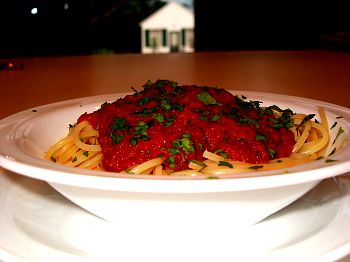
Pasta alla Napoletana

I
n the interest of full disclosure, I feel compelled to say, I've never been to Naples. I've been close, but somehow, never made it those few last miles to the city limits. Nevertheless, when I ordered Pasta alla Napoletana at a trattoria in Salerno, for example, I felt enough kinship with the Napoletani, that I felt I would be getting the real McCoy.

I learned about Pasta alla Napoletana, pasta with sausage and peppers in tomato sauce, from two wonderful folks who probably showed up on Public Television just a year or two before their time: Franco and Margaret Romagnoli. Their TV show, "The Romagnoli's Table," gave me my first insight into Italian regional cuisines, and provided the notion that I could indeed produce great Italian meals with my hand-me-down Revereware pots; given the right ingredients. Over time, Pasta alla Napoletana has been among those dishes.

Note: I had an epiphany yesterday when I cooked the peppers for this dish. I've written and published recipes for roasted peppers in which I've described roasting them under a broiler, but in fact, I probably haven't cooked them that way for fifteen years. Well, due to circumstances like needing propane, and having a ceramic cooktop, I could neither grill them, nor char them over a gas flame on the stove as I have in the past. So I did indeed cook them under the broiler. They were fabulous.

I want to write more about this, but for now, I'm going to hold it in abeyance for another blog post. For this recipe though, I'll include instructions for roasting peppers under the broiler.

Pasta alla Napoletana
Pasta with Sausage and Peppers in Tomato Sauce

Ingredients:

3 Large bell peppers
4 Cloves garlic, peeled and thinly sliced
2 - 3 Tbs. Extra-virgin olive oil
1 28 oz. Can Italian plum tomatoes (Preferably San Marzano)
2 Tbs. Fresh oregano, finely chopped
4 Tbs. Fresh basil, finely chopped
1/2 tsp. crushed red pepper flakes
Approximately 1 1/2 Lb. Italian sausages, cut into bite-sized pieces
Salt & freshly ground black pepper
1 Lb. Rigatoni
4 Tbs. Flat-leaf Italian parsley, finely chopped
Parmesan

Preparation:

Set one of your oven racks high enough to allow the peppers to roast approximately six inches away from the heat.

Preheat the broiler.

Place the peppers on a sheetpan, and put the sheetpan in the oven. Watch very closely—checking, literally once every minute or so—as the peppers' skin begins to blacken. Turn the peppers to expose the uncooked portions to the heat as their skins become charred.

As the peppers become blackened all around (this may not happen to all of them at the same time), remove them from the oven and seal them in a paper bag. Use only paper, as the paper will absorb moisture exuded by the peppers as they cool. Plastic or aluminum foil will hold moisture, and cause the peppers to become soggy.

Leave the peppers sealed in the bag for approximately fifteen minutes, then remove them and peel the charred skins. You can remove any uncooked portions of skin with a vegetable peeler. Remove the cores and seeds, cut the peppers into rough squares, and reserve.

Note: You can do this step well in advance, and simply have the peppers available at cooking time.

Heat a four quart saucepan over medium heat, then add the olive oil. Add the garlic and cook, stirring, for approximately one minute.

Remove the pan from the heat and add the tomatoes, breaking them up with the back of a fork as they go in. Add the oregano, basil, and pepper flakes and bring the sauce to a simmer.

Add the sausages and peppers, season with salt and pepper, and regulate the heat so the sauce barely simmers. Cook for approximately one half hour.

Approximately 15 minutes before serving, bring a large pot of water (at least six quarts) to a full, rolling boil and add the pasta. Cook until just al dente. Drain in a colander, and pour the pasta out onto a serving platter.

Spoon the sausages and peppers over the pasta, then pour the remaining sauce over all. Garnish with the parsley, and serve family-style at the table. Pass the Parmesan separately.

Serves four.

Technorati tags: , ,

Labels: ,

Sunday, June 19, 2005

Bistecca alla Pizzaiola

O
ne of the very few problems I've had living here in southeastern Connecticut has been an unpredictable supply of fresh herbs at the local mega-stores. And while my own basil, thyme, sage, rosemary, and nepitella, are growing apace in my new garden, I was grateful when one of my new friends stopped by over the weekend with a large plastic bagfull of fresh oregano. It goes without saying, I began to think about Salsa Pizzaiola, Pizza maker's tomato sauce, right away. Fresh oregano is sine qua non for Salsa Pizzaiola. And other than pizza, what better use for Salsa Pizzaiola than Bistecca alla Pizzaiola, Steak, Pizza Maker's-Style?

I wrote in La Cucina dei Poveri about my great uncle Emanuel visiting our summer cottage in Old Saybrook, CT., invariably bringing with him, a few steaks that he, my grandfather, and my great uncle Louie would turn into il miracolo, the miracle, as my uncle referred to Bistecca alla Pizzaiola. And my partiality for steak treated so kindly has remained unflagging since.

While a Pizzaiuolo Napoletano, Neopolitan Pizza Maker, was likely to have been the first person to have combined steak with tomato sauce, the reason is unclear. Except perhaps, that the steak in question might have been less palatable without additional flavoring. And of course, that flavoring would have come from the sauce for pizzas.

The "red sauce joints" here in America typically serve Bistecca alla Pizzaiola with pasta, but in Italy, the traditional accompaniment is puré di patate, mashed potatoes.

Note: You can make the sauce in advance, and refrigerate until ready to assemble the dish. Simply warm the sauce in a sauté pan, and simmer the cooked steak in the sauce for approximately five minutes before serving.

Bistecca alla Pizzaiola
Steak, Pizza Maker's-Style

Ingredients:

For the sauce:

3 — 4 Tbs. Extra-virgin olive oil
2 Cloves garlic, peeled and thinly sliced
1 28 oz. Can diced Italian plum tomatoes (preferably San Marzano)
4 Tbs. Fresh oregano, finely chopped
4 Tbs. Flat-leaf Italian parsley, finely chopped
1/2 tsp. Crushed red pepper flakes
Salt & freshly ground black pepper
4 Tbs. Flat-leaf Italian parsley, finely chopped

For the steaks:

Extra-virgin olive oil
2 N.Y. Strip steaks (approximately 1/2 Lb. each)
Salt & freshly ground black pepper
1/2 Cup dry red wine

Preparation:

Heat a large sauté pan over medium-high heat, then add the oil. Add the garlic, and sauté for approximately one minute. Remove the pan from the heat and add the tomatoes and their juices.

Return the pan to the heat, and add the oregano, parsley, and red pepper flakes. Season with salt and pepper, reduce the heat, and simmer gently for approximately twenty minutes, until the sauce has thickened, and the extraneous liquids have cooked off.

When the sauce is nearly done, heat another sauté pan over high heat and add enough olive oil to cover the pan bottom. While the oil heats, season the steaks on both sides with salt and pepper.

Place the steaks in the pan, and cook for four minutes on each side (for medium-rare). Resist the temptation to disturb the steaks as they cook in order to get the best caramelization. Remove the steaks from the pan, cover loosely with aluminum foil, and allow the steaks to "rest" for five to ten minutes.

Meanwhile, return the pan to the heat, and add the red wine. Cook, scraping up any browned bits of meat from the pan bottom, until the liquid has reduced by approximately half. Add the reduced wine to the sauce, and stir to combine.

Slice the steaks crosswise, on a slight bias, and add the slices to the sauce. Simmer for approximately five minutes.

To Serve:

Divide the steak slices and sauce equally among four dinner plates, and garnish with the chopped parsley. Serve with mashed potatoes, and perhaps a green salad.

Serves four.

Technorati tags:  , ,

Labels: ,

Tuesday, June 14, 2005

Peposa alla Fornicina

M
y dearest friend here in southeastern Connecticut is a fellow who compares favorably to my perception of Calvin Trillin's "man with the naugahyde palate." That is to say, for example, given a choice between quality and quantity in culinary matters, quantity prevails every time. In his defense, though, I've never actually seen him pull his chair up to the buffet table in an all-you-can-eat restaurant. But I have seen a couple of hosts develop a slight pallor as they've escorted him to his table.

And while he seems to have reduced eating to its barest essentials, he has a small quirk that suggests a degree of discernment, indicating perhaps there was a time when he could identify a dish with flavor: he applies freshly-ground black pepper to every meal before he tastes it. I suspect it's a habit he developed over the course of four years spent eating tasteless food three times per day at a New England prep school.

I thought of my friend right away when I came across an old Tuscan recipe, Peposo alla Fornicina, Beef Stew in the style of the Kiln Worker. Peposo's key ingredient is black pepper.

The history of Peposo begins in approximately 1437, when Filipo Brunelleschi was supervising construction of the dome on La Chiesa Santa Maria del Fiore, the Duomo in Florence. At the start of the business day, one of the kiln workers would toss the ingredients for Peposo into a clay pot and put it into the kiln in which the terra cotta tiles for the dome were fired, where it would cook for several hours. At lunchtime, runners would shuttle bowls of the stew up to the tile workers on the dome

The tile workers seemed to like the stew well enough, but the notion of spending their lunch hour on the dome—depriving them of the chance to play a few friendly hands of Scopa——didn't go over well at all, causing a small rebellion among them that may have amounted to the first labor strike in Italy.

History becomes weak about the origin of the dish, though. Credit seems to go, —in equal measure, —to nearly any town near Florence that had even a small tile making facility. Among those laying claim to Peposo, are Pistoia, Impruneta, and even La Spezia, in the province of Liguria. It goes without saying that all the towns making such a claim include the detail that dottore Brunelleschi visited each of them to select his tiles one at a time.

Beyond the pepper that characterizes Peposo, the stew is no more than a combination of meat, garlic, and red wine, cooked at low heat for several hours, with a wonderful outcome. Over time, cooks embellished the dish with tomatoes, mushrooms, onions, or all three ingredients. Brunelleschi's stew did not likely include tomatoes, though, as they didn't appear in Italy until the mid sixteenth century at the earliest.

By tradition, Tuscans serve Peposo over crostini, toasted bread. When I cooked it on Sunday evening, I served it over polenta. I imagine it would be delicious with roasted potatoes as well.

As we sat down to dinner, I offered my friend the pepper mill. Having heard the history of the dish, though, he replied, "I'll wait until I've tasted it. Thanks."

Peposo alla Fornicina
Beef Stew, Kiln Worker's-Style

Ingredients:

2 Lb. Beef stew meat, cut into bite-sized chunks
10 Cloves garlic, peeled, but left whole
1 - 2 Tbs. Crushed black peppercorns
3 - 4 Cups dry red wine
Salt
4 1 in. Slices rustic bread
1 Clove garlic, peeled and halved

Preparation:

Pre-heat the oven to 250 F.

Place the meat and garlic in an ovenproof casserole. Sprinkle the crushed peppercorns over all. Add enough red wine to cover the meat by approximately one inch.

Bring the casserole to a simmer on the stove, then cover, and place the casserole in the center of the pre-heated oven. Cook, adjusting the heat so the stew barely bubbles, for approximately six hours. If the liquid reduces too much while the stew cooks, add hot water to compensate.

At the end of cooking, the sauce should be thick enough to coat a spoon, and the meat should be falling apart. Taste, and season the stew with salt as necessary.

At serving time, toast the bread slices, and rub them with the garlic halves.

To Serve:

Place one slice of the toasted bread in each of four soup bowls, then divide the stew equally among them.

Serves four.

Technorati tags: , ,

Labels: ,

Thursday, June 09, 2005

Spuntature e Faggiole

W
hen I see the delivery truck from Westerly Meat Packing Co. in the parking lot at Universal Food Store of Noank, I consider it to be a good sign. When I walk into the store to find my friend Frankie, laying in a supply of "country-style" spare ribs, I consider it to be serendipity. And when I've laid in my own supply of "country-style" spare ribs, my thoughts turn to Tuscany, and Spuntature e Fagioli, spare ribs and beans.

Tuscans work miracles with beans. The humble cannellini, white bean, or borlotti, cranberry bean, become enobled in dishes like Zuppa di Fagioli, Tuscan Bean Soup; the legendary Ribollita, "Re-boiled" soup; or as antipasti like, Gamberi e Fagioli, Shrimp with Beans, or Fagioli con Calamare alla Griglia, Grilled Squid with Beans. Of course, a little transcendent extra-virgin olive oil dosen't hurt any of these dishes either.

Italians use the term spuntature to refer to either "country-style" spare ribs, or pork chops. (Although the more generic term for chops of any kind is costolette.) And the pork ribs they commonly use, come from the belly side of the pig. While we don't typically butcher pigs the same way here, "country-style" ribs—which come from a pig's back, and near the shoulder—come closest. I feel confident, though, if a Tuscan farmer had some pork shoulder sitting in the larder, La Signora would have no problem substituting that for the ribs.

Sausages also find their way into spuntature e fagioli from time to time; again, depending on the season and the contents of the larder. And it goes without saying, sausages and beans are a magical combination on their own.

I understand we think of dried beans as a fall or winter ingredient, but spare ribs and beans warms this Tuscan heart any season of the year.

Spuntature e Fagioli
Spare Ribs and Beans

Ingredients:

For the Spare Ribs:

Extra-Virgin olive oil
2 Lbs "Country-style" pork spare ribs
2 Cloves garlic, peeled, and finely chopped
1 Cup dry red wine
2 Tbs. Tomato paste dissolved in 2 Tbs. water (or red wine)
1 28 oz. Can, Italian plum tomatoes (preferably San Marzano)
Salt & freshly-ground black pepper

For the Beans:

1 Medium yellow onion, quartered
1 Carrot, peeled, and roughly chopped
1 Stalk celery, washed, and roughly chopped
4 Tbs. Flat-leaf Italian parsley
2 Cloves garlic, peeled
4 Tbs. Olive oil
1 Lb. Dried cannellini, great northern or Navy Beans
1 Sprig fresh rosemary, leaves only
4 Fresh sage leaves, finely chopped
Salt & freshly-ground black pepper
Flat-leaf Italian parsley (for garnish)

Preparation:

Heat a sauté pan large enough to hold the spare ribs over medium-high heat, then add enough olive oil to film the bottom. Carefully add the ribs, and cook until they've browned well on both sides; approximately seven minutes per side.

Drain the rendered fat from the sauté pan, then add the garlic, shaking the pan constantly, to avoid burning. Turn the heat to high, then add the wine. When the alcohol has boiled off, about two minutes, add the tomato paste and the plum tomatoes, breaking them up with the back of a fork as they go in.

Bring the pan to a boil, then reduce the heat to a slow simmer and cook for two hours, stirring occasionally. It may be necessary to add water from time to time to maintain a reasonable consistency.

While the spare ribs are simmering, turn your attention to the beans:

Place the onion, carrot, celery, parsley, and garlic in the bowl of a food processor and pulse ten times for about one second each pulse.

Heat a soup pot over medium-high heat, then add the olive oil. Add the chopped vegetables to the oil, lower the heat slightly, and cook, stirring occasionally, for eight to ten minutes; until they're well blended, softened, and slightly caramelized.

Add the beans and enough water to cover by about one inch. Add the rosemary and sage, then season with the salt and freshly-ground black pepper. Bring to the boil, then lower to simmer and cook, partially covered, for one to one and a half hours, until tender. Drain in a colander and reserve.

When the spare ribs are done, return the beans to the soup pot, add the spare ribs and tomato sauce, and cook at a low simmer for about thirty minutes. Taste for salt and pepper and add to your taste if necessary.

To serve:

Place one spare spare rib in each of four plates, serve some beans to the side, then spoon about a quarter cup of sauce over the beans. Finally, garnish each plate with a sprinkling of the flat-leaf Italian parsley.

Serves four.

Technorati tags:  , ,

Labels: , ,

Monday, May 23, 2005

Pasta con le Regaglie

L
ast week, I came into possession of some turkey giblets. The whole deal had a surreptitious quality about it that I loved. A chef friend was going to prepare Turkey Divan, and had no use for them. But she extended the offer sotto voce, perhaps because she wasn't sure if I liked turkey giblets, and that added to the intrigue. This wasn't the first time I'd been involved in deals like this.

Several years ago, when I lived in Boston, my upstairs neighbor was a cook at the former Jasper's on Commercial Street. Jasper White had created a culinary niche cooking upscale versions of classic New England dishes. My neighbor would call me at work from time to time, and, using a conspiratorial tone of voice, would inform me that Jasper was making his lobster rolls that evening. So I'd make a bee line to Jasper's at the end of my workday, sit at his small bar, and practically inhale one of his lobster rolls. Jasper's lobster rolls were well worth being part of any kind of conspiracy; real or imagined.

But reflection on lobster rolls aside, turkey giblets are not the kind of foodstuffs that are readily available at the local megastore unless they come packaged in the turkey. So my little "score" was a particular treat. And for me anyway, the logical outcome to look forward to was Pasta con le Regaglie. (reh-GAHL-yay)

In the interest of full disclosure, I confess that my previous attempts at Pasta con le Regaglie have ranged from mediocre to dismal failure. In fact, I was feeling like Charlie Brown must have felt about kicking a football. Each time I tried it, I knew in my heart that it was going to be great. And each time, I wound up on my back.

The problem was a gristly texture that was about as appealing as chewing elastic bands. It seemed that no matter how thoroughly I dissected the giblets, or how diligent I was in removing connective tissue, I couldn't lose the gristle.

So I spent some time studying recipes on Italian web sites, and it seemed my problems related to the length of time I cooked the giblets. It turns out, this dish wants to be cooked for a long time. But I love Pasta con le Regaglie; sufficiently to try it one more time.

I discovered the dish many, many years ago, at a trattoria in Rome; I've been chasing it like some kind of Holy Grail ever since; and I believe with this recipe, I've caught it. The giblets help to create an intense, rustic, and earthy tomato sauce, while the livers lend a creaminess at the same time.

And despite the fact that Caterina de' Medici is said to have enjoyed giblet ragôut from time to time, this dish is a supreme example of la cucina dei poveri, the cooking of the poor.

Pasta con le Regaglie
Pasta with Giblets

Ingredients:

1 1/2 Lbs. Giblets (chicken or turkey)
2 Cloves garlic, peeled
1 Medium carrot, peeled and cut into chunks
1 Stalk celery, peeled and cut into chunks
1 Medium yellow onion, quartered
3 Tbs. Italian flat-leaf parsley, including stems
2 Oz. Pancetta, roughly chopped
2 Tbs. Extra-virgin olive oil
1 Cup dry white wine
1 14 Oz. Can low-sodium chicken broth
1 28 Oz. Can crushed or diced Italian plum tomatoes (preferably San Marzano)
1/2 tsp. Crushed red pepper flakes
Salt & freshly ground black pepper
1 Lb. Rigatoni
4 Tbs. Flat-leaf Italian parsley, finely chopped
Pecorino-Romano

Preparation:

Remove all connective tissue, visible fat, and silverskin from the hearts and gizzards. Chop into very fine dice, along with the livers, and reserve.

Place the garlic, carrot, celery, onion, parsley and pancetta in the bowl of a food processor and pulse ten or more times for about one second for each pulse. The resulting mixture is known as a batutto.

Heat a four quart pot over medium heat, then add the oil. Add the batutto, and cook for approximately ten minutes, until the vegetables have softened, and the pancetta has rendered its fat. Lower the heat if the vegetables begin to color.

Add the giblets to the pot, and continue cooking, shaking the pot from time to time, until the giblets have lost their pinkish color.

Raise the heat to high, and add the wine. Continue cooking over high heat until the wine has reduced to approximately 1/4 cup. Add the chicken broth, and cook over high heat until it has reduced by approximately half.

Lower the heat to medium-low, and add the tomatoes and the red pepper flakes. Adjust the heat so the sauce simmers gently. Season with salt and pepper, and simmer, uncovered, for approximately one hour, or until the sauce has thickened, and any extraneous liquid has cooked off.

Approximately fifteen minutes before the sauce should be done, bring a large pot with salted water (at least six quarts) to the boil. Add the rigatoni, and cook until the pasta has just reached the al dente state. Remove from the heat and drain in a colander.

To Serve:

Divide the pasta equally among four plates and add a dollop of sauce to each. Garnish with the parsley, and pass the Pecorino-Romano separately at the table.

Technorati tags: , , ,


Labels: ,

Tuesday, May 17, 2005

Pasta al Tonno e Pomodoro

I
've begun to think about writing a second edition of La Cucina dei Poveri for at least seventeen reasons: the seventeen recipes that either didn't make it into the first edition, or that I've unearthed since I published the first edition. Among the seventeen is this recipe; Pasta al Tonno e Pomodoro, Pasta with Tuna and Tomato Sauce.

My grandfather often made Pasta with Tuna Sauce when we were staying at our summer cottage in Old Saybrook, CT. In fact, that seemed to be the only place he made it. I've often wondered why.

Perhaps it was because, even though the tuna came from a can, it was a period (late fifties and early sixties) when foods weren't typically frozen, and we ate seafood only when someone caught it, or when it was available fresh at the market. In those days, that was from approximately May through September. For the rest of the year, even canned tuna, "out of season," just didn't seem right.

Pop's (my grandfather's) recipe differs from the traditional Sicilian version, because he added capers and roasted peppers; often hot peppers. For me, roasted peppers alone are close to nature's perfect food, but the combination of tuna, tomato, and roasted peppers is sublime.

Pasta al Tonno e Pomodoro is at its best, prepared with roasted fresh peppers, but you can find enough fine brands of jarred roasted peppers at your grocery store that you shouldn't be deterred from making this terrific pasta recipe.

Pasta al Tonno e Pomodoro
Pasta with Tuna and Tomato Sauce

Ingredients:

2 Tbs. Olive oil
2 Cloves garlic, peeled and thinly sliced
1 Medium onion, diced
2 6 oz. Cans tuna packed in oil
1/2 tsp. Crushed red pepper flakes
1 28 oz. Can Italian plum tomatoes, preferably San Marzano
2 Tbs. Capers
4 Roasted peppers, cut into 1 in. pieces
Salt and freshly ground black pepper
1 Lb. Penne rigate
4 Tbs. Flat leaf Italian parsley

Preparation

Heat a 4 quart pot over medium-high heat, then add the oil. Add the garlic, and cook, shaking the pot occasionally, for approximately one minute. Lower the heat to medium, then add the onion.

Season with salt and pepper, and cook until the onion softens and becomes translucent; approximately five minutes.

Add the tuna, breaking it up with a fork, then add the red pepper flakes. Add the tomatoes, breaking them up as they go in as well. Finally, add the capers and roasted peppers. Lower the heat and simmer for twenty minutes, stirring occasionally.

In the meantime, bring a large pot of salted water (at least six quarts)to the boil. Add the penne and cook until they reach the al dente state. Drain in a colander.

To Serve:

Divide the pasta equally among four plates and add a dollop of sauce to each. Garnish with the chopped parsley.

Serves four

Technorati tags: , ,

Labels: , ,

Monday, May 16, 2005

Carne Macinata Sfizioza

L
ast Wednesday evening, my next door neighbor, his girlfriend, and I gathered in the kitchen at my landlady's house to try to figure out supper for the evening. Regular readers will recall that the previous weekend, we were all laid low by illness, and none of us had done any serious shopping since.

MEDICAL UPDATE: My neighbor's girlfriend and I are perfectly fine, but doctors have determined that he and my landlady have bilateral pneumonia. We feel that's a good thing, though, because now they can take antibiotics specific to their pathology. The cough elixir with codeine doesn't hurt either.

As she was rummaging through her refrigerator, my landlady discovered a pound of hamburg that was about to turn toward heading one-eight-zero, as we say in this nautical community. In worldly terms, it was about to go south. Since I was going to cook, I was given the responsibility of figuring out what to do with it.

Except for the obvious—meatballs—I hadn't spent much time thinking about what Italians do with hamburg. Oh sure, ragù alla Bolognese, and the Sicilian dish, farsu magru came to mind; but among all of our kitchens, we couldn't put together the ingredients for either.

It didn't take much fishing around the Web, though, to discover this recipe. My problem, was translating the word, sfizioza.

I had never heard it before; it wasn't in either of my Italian-English dictionaries; and I didn't get any help from Google. But the kind folks in the language forums at Virtual Italia dot com, and Word Reference dot com provided me with helpful assistance.

It turns out that sfizioza is a derivative of the noun, sfizio, whim. So it seems reasonable to consider the translation of this dish to be 'hamburg made on a whim.'

And indeed, there's no more to this dish than sautéeing some onion and celery, adding some parsley and other herbs of your choice, coooking the hamburg, and finishing it with some marinara.

I wound up serving this dish with some plain, boiled Arborio rice, which caused my neighbor to remark, "Wow, this tastes like what the original makers of Hamburger Helper must have had in mind. But they couldn't have come up with this dish in their wildest fantasies."

Carne Macinata Sfizioza
Hamburg 'on a Whim' (Adapted)

2 Tbs. Extra-virgin olive oil
1 Medium onion, finely diced
2 Stalks celery, thinly sliced
4 Tbs. Flat-leaf Italian parsley, finely chopped
2 Tbs. Assorted herbs (Thyme, tarragon, oregano, etc.) optional
1 Lb. Ground Beef
1 Cup marinara
Salt & freshly ground black pepper

Preparation

Heat a large sauté pan over medium-high heat, then add the oil. Add the onion, celery, half the parsley, and the assorted herbs (optional), and sauté until the onion has softened and become translucent; about five minutes.

Add the hamburg, breaking it up with a wooden spoon, and sauté until it has lost all pinkness. Season with salt and pepper, and add the marinara. Stir well to combine, re-season if necessary, lower the heat to allow the mixture to barely simmer, and cook for approximately twenty minutes.

To Serve

Divide equally among four dinner plates, garnish with the remaining parsley, and serve with boiled rice.

Serves four

Technorati tags: , ,

Labels:

Wednesday, May 11, 2005

Pasta alla Caruso

W
hile I've recovered from the little virus I had over the weekend, I'm still licking my emotional wounds over missing that 50 to 1 longshot in the Kentucky Derby. After all, he was named in honor of my favorite opera composer, Giacomo Puccini. Alas, when it comes to the bangtails, I spend far too much time trying to quantify a race's outcome with mathematics, rather than hunches. And I remain squeamish at the notion of parting with $2.00 on a horse with post time odds of 50 to 1.

Nevertheless, the whole experience caused me to think about opera, which in turn, led to thoughts about one of my favorite pasta dishes, named in behalf of one of the greatest tenors in the history of opera: Pasta alla Caruso. So if I had a Jones for Pasta alla Caruso on Saturday, by the time I felt up to cooking pasta yesterday, I had a serious Jones. I rarely go more than two days without eating pasta.

Enrico Caruso's passion for food—and cooking—nearly equaled his passion for opera. During his tenure at the Metropolitan Opera House in New York, he sponsored the citizenship of more than a dozen chefs from his home town, Naples; possibly to repair his deprivation of the Napoletano cuisine he missed. Further, he helped them to open restaurants and pizzerias in Little Italy, and on evenings when he wasn't singing, he would spend time working in their kitchens.

But here's where the story of Pasta alla Caruso becomes muddy. Some food historians say he invented the dish and named it for himself; others say one of his Napoletano friends in New York invented it and named it in his honor. Still others say it was a chef in Naples who invented it and named it for one of Naples' favorite sons.

No matter. The combination of chicken livers, mushrooms, and a rich tomato sauce makes for a soul-satisfying primo piatto, first course. The chicken livers provide a creamy richness, the mushrooms, an earthiness, and the tomato sauce, a sweet acidity. The whole thing comes together like an aria from La Boheme.

Note: if you are indeed serving Pasta alla Caruso as a first course, make smaller portions than you ordinarily would with other recipes. The chicken livers make this a richer dish than, say, pasta alla marina.

Pasta alla Caruso
Pasta with Chicken Livers and Mushrooms in a Red Wine Tomato Sauce

Ingredients:

2 Tbs. Olive Oil
1 Cup Flour, seasoned with salt & freshly ground black pepper
1 Lb. Chicken Livers, separated into individual lobes, all visible fat removed
2 Tbs. Extra-virgin olive oil
2 Tbs. Unsalted butter
1 Lb. Assorted mushrooms, Portobello, Crimini, White button, sliced thinly
1 Cup dry red wine
1 28 Oz. Can, peeled Tomatoes (preferably San Marzano)
2 Tbs. Flat-leafed Italian Parsley, finely chopped
Salt & freshly ground black pepper
1 Lb. Spaghetti or Perciatelli
Parmigiano

Preparation:

Flour the chicken livers, shaking off any excess and reserve on a plate.

Heat a sauté pan over high heat, then add the olive oil. Add the chicken livers and sauté until they are slightly browned and firm. Remove from the, pan and reserve.

Pour off the olive oil, then add the two tablespoons of butter. When the butter has foamed and the foam begins to subside, add the mushrooms, tossing to coat with the butter. Cook for four or five minutes, until the mushrooms begin to give off some of their juices.

Add the wine all at once, scraping the bottom of the pan to loosen any caramelized bits of liver and mushroom from the bottom. Continue, cooking over high heat until the wine has reduced by about half. Lower the heat, puree the tomatoes through a food mill, or in a food processor, then add to the mushrooms and wine. Adjust the heat so the mixture barely simmers.

Slice the chicken livers crosswise into half-inch rounds and add them, with any of their accumulated juices, to the tomato sauce. Taste for seasoning, add salt and pepper if necessary, then cook over low heat for about thirty minutes, or until the extraneous juices have evaporated.

In the meantime, bring a large pot with about six quarts of water to a boil. Add the pasta and cook until al dente.

Drain the pasta, divide equally among four (or six) plates, top with the sauce, and garnish with the chopped parsley. Pass the Parmigiano separately at the table.

Oh, and try not to act surprised when one of your dinner guests suddenly discovers a long-hidden talent for Italian opera.

Serves four as an entrée, six as a first course.


Technorati tags: , ,


Labels: ,

Tuesday, May 10, 2005

Fritatta

W
e've been having a tough go of it here on Riverview Avenue this past week. First, my neighbor in the other apartment here was—and remains—laid low by the springtime flu. Then, my landlady developed a respiratory infection that causes her to sound like a snare drum when she coughs. I spent all of Sunday and most of yesterday in bed with a 36 hour virus; brought on, I'm certain, by that 50 to 1 longshot winner in the Kentucky Derby. After all, an event like that will lower anyone's resistance to infection. Especially anyone who hadn't taken any action on the horse. And finally, my neighbor's girlfriend joined the walking wounded yesterday too. As I said, tough week on Riverview Avenue.

Of course, the chicken soup has been flowing like water, but I was feeling well enough yesterday afternoon to have an interest in something more substantial. Given the current condition of my larder, the logical choice was frittata.

One of my Italian-English dictionaries defines frittata as an omelet. I can't see how this could be correct, though. As I've written elsewhere, it was Caterina de' Medici who taught the French how to eat with forks. I prefer to think of frittata as a srambled egg tart.

The significant differences between an omelet and a frittata are the cooking techniques. A mushroom omelet and a mushroom frittata might have identical ingredients, but the outcomes are drastically different.

An omelet consists of beaten eggs cooked until just set on the bottom, then folded over a filling. A frittata is an amalgam of ingredients cooked together. Also, a frittata is cooked until the bottom is set, then flipped and cooked on the other side.

In Italy, frittata is a popular piatto di pranzo, luncheon dish. And it's ubiquitous on the antipasto table in trattorias. I've eaten in some restaurants—particularly in Tuscany—where the chef offers three or four different frittate as antipasti. Italians typically eat frittata at room temperature.

Ingredients for a frittata are limited only by the contents of the larder, and the imagination of the cook. Asparagus, spinach, potatoes, or bell peppers are all popular, either alone, or in combination. Sausage, and sopressata are popular too.

The recipe I present below, is a simple combination of eggs and onions. If I had a bell pepper in the house, I would have diced it and sautéed it with the onions. If I had some sausage, I would have crumbled it and sautéed it before adding the onions. This dish is wide open for improvisation.

For as simple as this recipe is, the dish was delicious, if I say so myself. But I'm also glad to be feeling well enough to look forward to having some pasta tonight.

Frittata
Scrambled Egg Tart

Ingredients:

2 Tbs. Extra-virgin olive oil
1 Medium onion, diced
2 Cloves garlic, peeled and diced
6 Large eggs
2 - 4 Tbs. Parmigiano, grated
Salt & freshly ground black pepper
2 Tbs. Flat-leaf Italian parsley, finely chopped

Preparation:

Heat a 10 or 12 inch non-stick sauté pan over medium heat, then add the oil. Add the diced onion, and sauté until the onions have softened and become translucent; approximately five minutes.

In the meantime, break the eggs into a bowl and beat with the back of a fork. (I recall Julia Child, when talking about omlets, saying eggs should be beaten at least 100 times, and with the back of a fork.) Stir in the Parmigiano, season with salt and pepper and set aside.

When the onions are done, add the garlic and sauté for approximately one minute.

Raise the heat to medium-high and add the eggs. With a wooden spatula, imediately begin to push the eggs from the edges of the pan to the center, turning and shaking the pan to bring uncooked eggs back to the edges. Continue in this manner until the bottom is set, then begin lifting the edges to determine the degree of doness. The frittata is ready to be turned when the bottom has hardened and has begun to develop some caramelization.

Slide the frittata out of the pan and onto a dinner plate, then, balancing the dinner plate on one hand, place the pan—upside down—over the plate. Using one smooth motion, flip the pan and the dinner plate over so the frittata falls back into the sauté pan.

Note: You can rehearse this technique with a cold pan and a dinner plate, and perhaps a paperback book, or a potholder, until you've become comfortable flipping them over to transfer from one to the other.

Return to the heat, and cook for two to three minutes longer. Note there will be some carryover cooking when you remove the pan from the stove.

To Serve:

Slide the frittata onto a platter, garnish with the parsley, and, if serving for lunch, divide into four wedges. If serving as part of an antipasto, divide into eight wedges.

Serves four for lunch; eight as part of an antipasto.

Labels: , ,

Saturday, March 12, 2005

Marinara: Cornerstone of Southern Italian Cuisine

I
'm surprised that once again—with this incarnation of Skip's Italian Food Blog—the most common question readers ask is, "Do you have a good recipe for tomato sauce?" I've been answering this question since 1994, when I started my first Web site: northend.com. The answer is, "Yes I do."

What I've found to be more surprising, though, is the tone of the e-mails. The writers suggest that marinara, tomato sauce, is some kind of elusive holy grail. In my opinion, this couldn't be further from the truth. And in Emeril Lagasse's words, "It ain't rocket science."

But thinking further, it occured to me that in addition to being a fine sauce in its own right, marinara forms the basis for a significant portion of the southern Italian and Sicilian cuisines. So it's worthwhile to develop a recipe you really like. When you've done that, you'll have the wherewithal to turn it into a panoply of Italian dishes, and save approximately thirty minutes of cooking time for each of them.

I wrote in my first cookbook, La Cucina dei Poveri, that my grandmother always seemed to have some tomato sauce on hand that she used for a variety of recipes having nothing to do with pasta. For example, a judicious ladleful over some sautéed zucchini; or "just enough to color" some cannellini; or a dollop of sauce over some of her superb rice cakes. And even when she served marinara over pasta, she would poach three or four eggs in the sauce, and serve them atop the pasta.

Italian restaurant chefs always have a pot of marinara bubbling gently on the back burner, ready to become any one of a myriad of Italian sauces. If the restaurant has an open kitchen, you might be able to watch the chef sauté some garlic in olive oil, add a handful of calamari, perhaps some red pepper flakes, then a ladleful of marinara, and voilà: pasta with calamari. And in only about four minutes.

When I make marinara, I make at least double my original recipe. It keeps perfectly well in the refrigerator for a week or ten days. Given a week to think about it, you can always find a reason to use the leftover. And while I don't advocate freezing anything, I'm told that it keeps well in the freezer for up to six months.

Here then, are a very few dishes that become available when you've mastered basic marinara sauce:

♦ Pasta all' Amatriciana
Pasta with guanciale and onion. Note: Guanciale is air-cured hog jowl. If you can't find it at your local Italian deli, you can substitute salt pork. If you're a real purist, though, you can order it from the great folks at Niman Ranch.

♦ Pasta al' Arrabiata
Pasta with spicy tomato sauce. (Literally, "angry" pasta).

♦ Pasta con Calamare
Pasta with squid in tomato sauce.

♦ Pasta alla Boscaiolo
Pasta with mushrooms and tomato sauce (Literally, Woodsman's-style pasta).

♦ Canelloni
Rolled, stuffed pasta.

♦ Pasta Ripieno
Stuffed shells.

♦ Melanzane alla Parmigiana
Eggplant Parmesan.

Of course, these few dishes barely suggest the possibilities for using marinara in your kitchen. Once you've tried a few, I'm sure you'll find dozens more you'll want to cook.

And in nearly every recipe, it's simply a matter of sautéeing some ingredients, adding the marinara and heating it through, and you're done. While I'm not averse to spending two or three hours fussing over recipes, this is my kind of day-to-day cooking.

Buon appetito!

My Grandmother's Marinara

Ingredients:

Olive oil
4 Cloves garlic, peeled, and thinly sliced
2 28 oz. Cans peeled tomatoes (preferably San Marzano)
1 Small carrot, finely shredded
1/2 tsp. Red pepper flakes
2 Tbs. Fresh oregano, finely chopped
2 Tbs. Fresh basil, finely chopped
1/4 Cup Flat-leaf Italian parsley, finely chopped
Salt & freshly-ground black pepper

Preparation:

Heat a three or four quart pot over medium heat, then add enough olive oil to cover the bottom. Add the garlic, and sauté, shaking the pot for about one minute, until the garlic begins to give up its aroma.

Remove the pot from the heat and add the tomatoes. Return the pot to the heat and begin to break the tomatoes with either the back of a fork, or a wooden spoon. Simmer the tomatoes to evaporate some of the liquid, then add the carrot, the red pepper flakes and the oregano.

Simmer gently for about twenty minutes, or until the sauce has thickened and the clear liquid from the tomatoes has evaporated.

Add the basil and parsley, and season with salt and pepper.

Makes approximately 1 1/2 Quarts.

Labels: , ,